
Another monumental bike ride, this time deep into the Buda Hills to visit the last Hungarian home of composer and ethnomusicologist Bela Bartok.
To say Hungary punches above its weight musically is an understatement. Composers Kodaly, Bartok, Liszt and Ligeti hail from here. The number of top-flight conductors from this small nation is almost beyond belief: Szell, Ormandy, Dorati, Reiner, Solti.
Bartok chain-smoked, liked to wear sandals and collected bugs, shells and rocks. His work is often described as violent and dissonant. His only opera and ballet, “Bluebeard’s Castle” and “The Miraculous Mandarin,” respectively, are vortexes of bloodlust. Life in an increasingly fascist state will do that to you.
His chamber works, in particular, are infused with the folk music of the countryside. For years Bartok would walk the back roads of Hungary, Transylvania (now Romania) – even Turkey – with a phonograph strapped to his back, recording the music of peasants on wax cylinders. He needs were simple, almost monk-ish. Tobacco seemed to be his only vice. Perhaps the greatest musician of the 20th century, he remains underappreciated, though his Concerto for Orchestra and Piano Concerto No. 3 frequently crop up on radio playlists.
For the 90 minutes I visited, no car or tour bus pulled up. No other visitor came or left. The place is not easy to find, nor does it seem to invite traffic. You must ring a sidewalk bell and state through an intercom your intention to visit.

Once inside, I was given a private tour by Agnes. Recently in Europe I’ve had
good fortune getting one-on-one treatment in this regard. It wasn't a tour per se. I was allowed to wander around freely, and any time I leaned forward to look at something, Agnes would describe it to me. For each of my questions she had a ready answer.

A chamber where concerts are still given. A piano trio will perform Mozart and Brahms here on Sunday. I’m thinking about it.

Bartok in youth and middle age. He was a sickly kid. For some reason, that tends to focus one’s energies later in life.

Bartok’s study. He wrote a lot in this room. Like Beethoven, he was a superb pianist. Just six years ago, one of his half-smoked cigarettes was found deep within this instrument.

Yes, he would strap this recording phonograph to his back while walking Central Europe’s muddy, rutted ox paths.

On less strenuous days, a horse-drawn cart did the work.

Folk instruments collected on his travels.

The detritus of a lifetime.
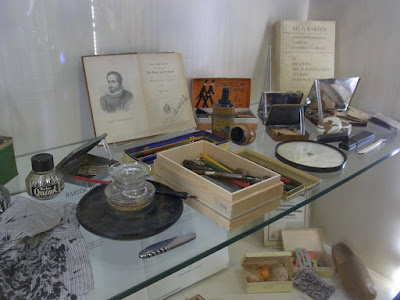
In the bottom right corner of this box is a fork-shaped fountain pen Bartok would dip in ink and use to draw his musical staffs – the five horizontal lines on sheet music that contain notes, rests and other musical symbols.

“Everything I did in life, I did for Hungary,” he wrote. Or something like that.

In the foreground, not a pocket watch, but a pocket metronome. Priceless and highly unusual.

Bartok’s last composition, his Third Piano Concerto. At the bottom right he wrote with portent and emphasis "Vege," or "the end."

Bela Bartok died in New York City in 1945 without two forints to rub together. Fewer than a dozen people attended his funeral.
 Bela Bartok Emlekhas
Csalan Utca 29, Buda
10-5 Tuesday-Sunday
Tram 56 north from Moszkva Ter will get you in the neighborhood after seven stops. Good luck with that.
1200 HUF


